


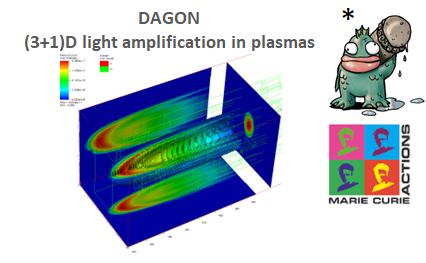
Dagon [1] is a time-dependent 3D computational code that solves the Maxwell–Bloch equations in inhomogeneous plasmas. It was developed by Dr. E. Oliva at the “Guillermo Velarde” Institute of Nuclear Fusion, Universidad Politécnica de Madrid (UPM).
Using Dagon, the following studies and experimental replications have been carried out:
- Amplification experiments in a Ni-like krypton optical-field-ionization (OFI) laser [2]
- The use of structured light to optimize the duration of amplified extreme ultraviolet (XUV) pulses [3]
- Amplification of high-order harmonics carrying orbital angular momentum in plasmas [4]
- Cavity-free lasing in nitrogen plasma filaments [5]
References
[1] E. Oliva et al., “DAGON: a 3D Maxwell–Bloch code,” Proc. SPIE 10243, 1024303 (2017). https://doi.org/10.1117/12.2265044
[2] F. Tuitje et al., “Nonlinear ionization dynamics of hot dense plasma observed in a laser-plasma amplifier,” Light: Science & Applications 9, 187 (2020). https://doi.org/10.1038/s41377-020-00424-2
[3] A. Kabaciński, E. Oliva et al., “Spatio-temporal couplings for controlling group velocity in longitudinally pumped seeded soft X-ray lasers,” Nature Photonics 17(4), 354–359 (2023). https://doi.org/10.1038/s41566-023-01165-5
[4] S. López, M. del Valle Pérez-Fajardo, E. Oliva, “Diagnosing the electron density of plasma amplifiers using XUV vortex beams,” Optics Express 33, 46285–46303 (2025). https://doi.org/10.1364/OE.570080
[5] S. López, A. García, D. Rueda, E. Oliva, “3D modelling of cavity-free lasing in nitrogen plasma filaments,” Optics Express 31, 8479–8493 (2023). https://doi.org/10.1364/OE.478100
LATEST NEWS
Plasma diagnostics using high-order harmonics (HOH) carrying orbital angular momentum (OAM)
11 de May de 2026
One of the most widely used techniques for plasma diagnostics...
READ MORE DeepOne: 1D Maxwell-Bloch
11 de May de 2026
* Imagen cedida por François Launet, “Goomi” DeepOne [1] is...
READ MORE Light quasiparticles in atmospheric plasmas
10 de May de 2026
In this line of research, we investigate how to transform...
READ MORE