







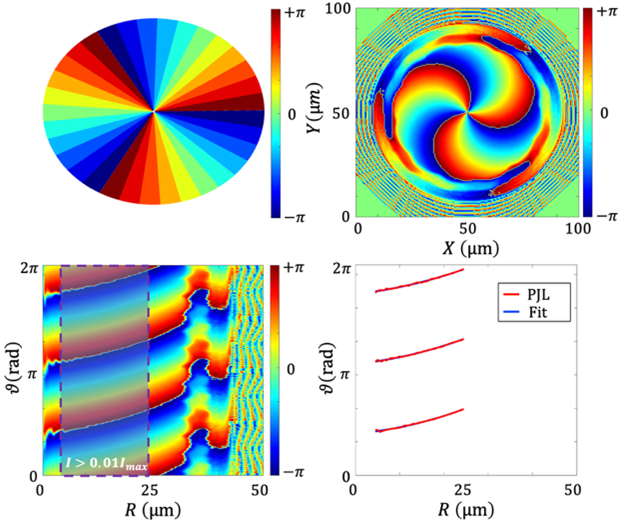
One of the most widely used techniques for plasma diagnostics involves injecting external beams that act as plasma probes [1]. Characterizing the phase of this beam upon exit can provide fundamental information about the plasma’s electron density [2,3]. Therefore, it is
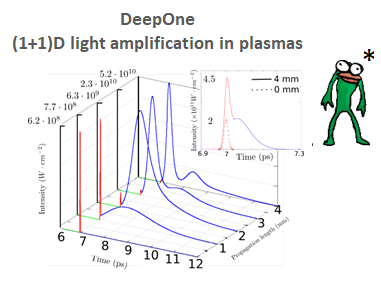
* Imagen cedida por François Launet, “Goomi” DeepOne [1] is a 1D time-dependent code that solves the Maxwell-Bloch equations in inhomogeneous plasmas. It was developed by Dr. E. Oliva at the Laboratoire d’Optique Appliquée (ENSTA, École Polytechnique, CNRS) and is
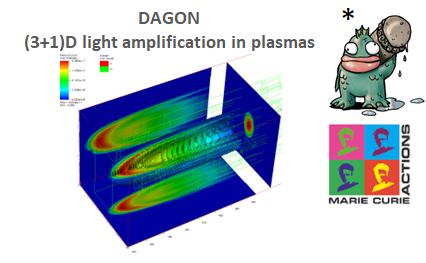
*Imagen usada con permiso de su autor, François Launet “Goomi” www.goominet.com Dagon [1] is a time-dependent 3D computational code that solves the Maxwell–Bloch equations in inhomogeneous plasmas. It was developed by Dr. E. Oliva at the “Guillermo Velarde” Institute of
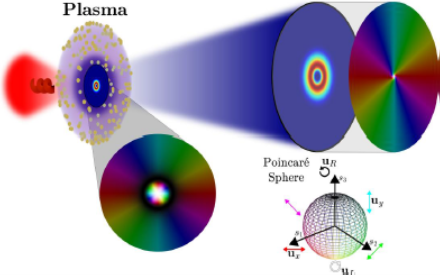
In this line of research, we investigate how to transform laser pulses into topological light quasiparticles. When an intense optical vortex is fired into air to generate a plasma, the light naturally evolves into complex topological structures known as skyrmions.
We have developed a new computational code capable of simulating light–matter interactions with atmospheric atoms and molecules, such as nitrogen. The code solves the 3D Maxwell–Bloch equations for a three-level system, enabling the investigation of quantum interference effects. What makes

Developed for modeling the filamentation of ultrashort lasers, Acherus is a (2+1)D spatio-temporal laser filamentation package for Python. It solves the Nonlinear Envelope Equation (NEE) for ultrashort laser pulses propagating through optically transparent and dispersive media—gases (air), liquids (water), and