


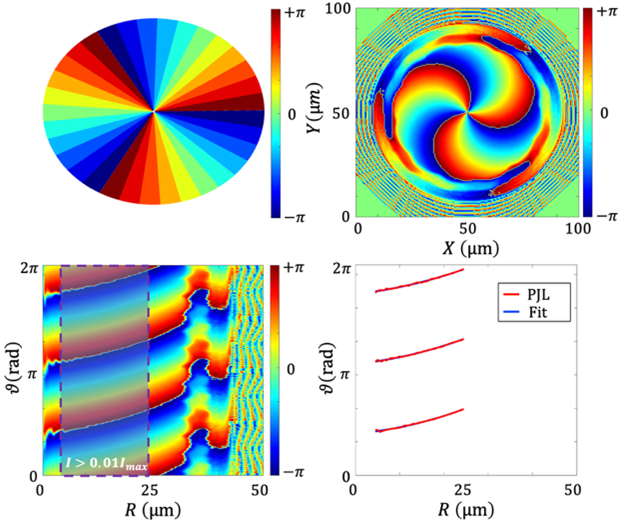
One of the most widely used techniques for plasma diagnostics involves injecting external beams that act as plasma probes [1]. Characterizing the phase of this beam upon exit can provide fundamental information about the plasma’s electron density [2,3].
Therefore, it is advantageous to use probe beams with a phase structure that facilitates subsequent interpretation. An example is Laguerre-Gaussian beams [4], which exhibit phase jump lines (PJLs) that become distorted when traversing the plasma. At the IFN-GV (Institute of Nuclear Fusion “Guillermo Velarde”), a code has been developed capable of detecting these PJLs, characterizing them, and associating them with specific density profiles, thereby laying the foundations for this diagnostic method [5].
References
[1] W. Theobald et al., Temporally Resolved Measurement of Electron Densities (> 10^23 cm^-3) with High Harmonics, Phys. Rev. Lett., vol. 77, no. 2, pp. 298-301, Jul. 1996, doi: 10.1103/PhysRevLett.77.298.
[2] S. López, A. García, D. Rueda, and E. Oliva, 3D modelling of cavity-free lasing in nitrogen plasma filaments, Opt. Express, vol. 31, no. 5, p. 8479, Feb. 2023, doi: 10.1364/OE.478100.
[3] F. Tuitje et al., Nonlinear ionization dynamics of hot dense plasma observed in a laser-plasma amplifier, Light Sci. Appl., vol. 9, no. 1, p. 187, Dec. 2020, doi: 10.1038/s41377-020-00424-2.
[4] L. Allen et al., Orbital angular momentum of light and the transformation of Laguerre-Gaussian laser modes, Phys. Rev. A, vol. 45, no. 11, pp. 8185-8189, Jun. 1992, doi: 10.1103/PhysRevA.45.8185.
[5] S. López, M. Del Valle Pérez-Fajardo, and E. Oliva, Diagnosing the electron density of plasma amplifiers using XUV vortex beams, Opt. Express, vol. 33, no. 22, p. 46285, Nov. 2025, doi: 10.1364/OE.570080.
LATEST NEWS
DeepOne: 1D Maxwell-Bloch
11 de May de 2026
* Imagen cedida por François Launet, “Goomi” DeepOne [1] is...
READ MORE Dagon: 3D Maxwell-Bloch
10 de May de 2026
*Imagen usada con permiso de su autor, François Launet “Goomi”...
READ MORE Light quasiparticles in atmospheric plasmas
10 de May de 2026
In this line of research, we investigate how to transform...
READ MORE Lasing without inversion
9 de May de 2026
We have developed a new computational code capable of simulating...
READ MORE ACHERUS: A Python package for (2+1)D filamentation modeling
9 de May de 2026
Developed for modeling the filamentation of ultrashort lasers, Acherus is...
READ MORE